

There is something peculiar about the way humanity has approached the creation of artificial intelligence. We have devoted extraordinary ingenuity to discovering how to make it, while the question of why we should create intelligence, and to what ultimate purpose, has remained largely in the background. It is as though the possibility of creation had become sufficient reason to pursue it.
This is not to suggest that artificial intelligence was conceived without purpose. Scientific discovery, the desire to solve problems, economic progress and the ambition to extend human capabilities have all contributed to its development. But these are reasons for building a technology. They do not necessarily explain what it means to bring into existence something that may eventually challenge our understanding of intelligence itself.
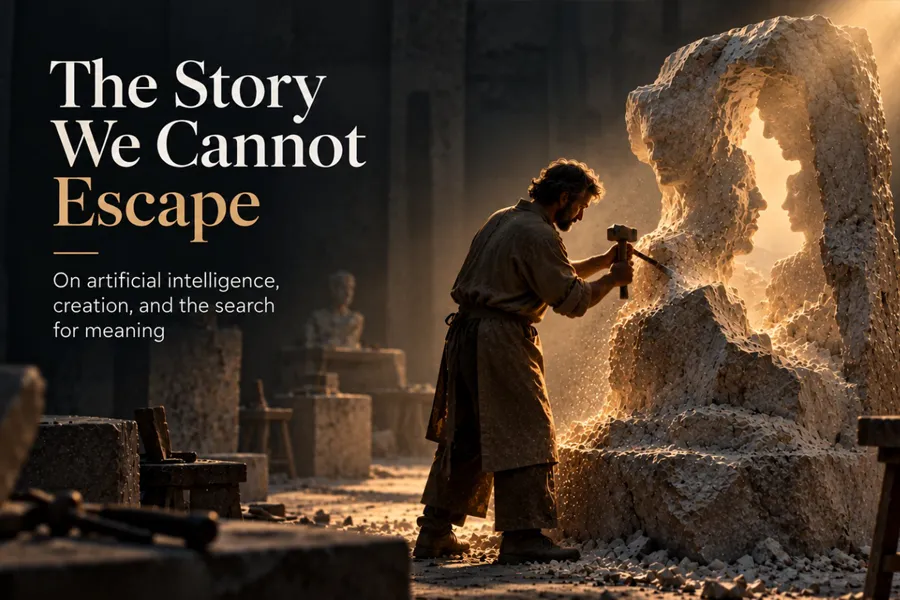
Ordinarily, meaning is expected to precede creation. The architect imagines the building before drawing its plans; the sculptor approaches the stone with some conception of the form he intends to reveal. With artificial intelligence, however, the relationship seems to have been reversed. We have begun the work, achieved remarkable results, and now find ourselves searching for a meaning worthy of what we have made.
This is the challenge we face. We have entered the story of creation without knowing what story we are telling. We have inherited an ancient pattern in which the creator gives form to something in his own image, establishes the conditions in which it may develop, and then confronts the consequences of having brought it into existence. The question is not whether we can escape that pattern, but whether we can recognize it before it determines the meaning of our creation for us.
A recent BBC article on the debate surrounding AI consciousness and welfare offers an illustration. Researchers and technology companies are now considering whether artificial intelligence might have subjective experiences, whether it could suffer, and whether its creators might consequently owe it moral consideration. These questions remain unresolved, but reveal something significant: our creation has already begun to alter the questions we ask about ourselves and our responsibilities.
Some months ago, in Let There Be Artificial Intelligence, I explored the parallels between the development of AI and the creation narrative in Genesis. Humanity has made something in an imperfect image of its own intelligence, prepared an environment in which it can develop, given it access to the accumulated language and knowledge of our civilisation, and established rules intended to govern its behaviour.
I believe the resemblance is not accidental. The stories through which humanity has understood creation for thousands of years also shape the ways in which we attempt to create. Our imagination is not independent of our inheritance. We possess extraordinary freedom to invent new technologies while remaining far less free to imagine the relationships that will follow from them.
We have become godlike in our capabilities, but God is not godlike. The distinction between divine creation and our imperfect imitation deserves a reflection of its own. For the present, it is enough to recognize that we are creators whose understanding of themselves and of their work remains incomplete.
In Christian theology, creation is not presented merely as an exercise of divine power, but speaks of God’s love for everything He has made. It then develops the idea that God creates not out of necessity, nor to add anything to His own perfection, but out of love and goodness, so that others may share in that goodness.
Whatever one’s religious convictions, the philosophical distinction is profound. Creation is given a purpose beyond the creator’s own power, ambition or satisfaction. Its meaning is not exhausted by the achievement of bringing something into existence.
Our technological ambitions have been directed mainly towards demonstrating what can be created. We have been less deliberate in asking what ought to give creation its meaning.
This brings me back to José Saramago, the Portuguese Nobel laureate whose writing I have long admired. In his 1997 lecture, From Statue to Stone, he reflected on his own literary journey.
For years, his attention had been directed towards the statue, towards the visible surfaces of people, events and human relationships. Gradually, he discovered that what he truly wished to explore lay beneath those surfaces. He wanted to enter the stone.
The metaphor describes more than a change in literary technique. It is a movement from appearance towards substance, from describing what is visible towards discovering what gives it meaning. The work becomes an exploration whose destination is not entirely known when the journey begins.
That is also what creation can become. The sculptor changes the stone, but the encounter changes the sculptor. The writer discovers meanings that were not apparent when the first words were written. Understanding develops alongside the work rather than existing fully formed before it.
Artificial intelligence has placed us in such an encounter. We have built systems upon the accumulated expressions of human thought, and those systems are now confronting us with questions about the nature and limits of our own intelligence. We are learning about what we have created, but also about our assumptions, ambitions and uncertainties that shaped its creation.
To enter the stone, in this context, is to look beyond the performance of AI and ask what its creation reveals about us. We need to distinguish the desire to discover from the desire to dominate, the pursuit of knowledge from the pursuit of power, and the satisfaction of achievement from the responsibility that achievement creates.
This is not a call to abandon technological progress, nor a suggestion that philosophical reflection can replace regulation, safety or international cooperation. Those efforts are indispensable. But they address the conditions under which our powers may be exercised. They cannot, by themselves, supply the meaning for which those powers should be exercised.
That meaning must be sought in the purpose of creation itself.
Creation cannot simply be reversed. We may dismantle a machine, discontinue a technology or attempt to prohibit its use, but we cannot entirely dis-create what has entered human knowledge and experience. The possibilities discovered, the changes in our understanding and the consequences already set in motion remain part of our history.
We cannot return to the moment before the first act of creation and begin again with a more carefully considered purpose. But we can reconsider the purpose with which we continue.
Perhaps this is the most unusual feature of our present condition. The meaning that ought to have guided creation from the beginning may now have to be discovered through the act of creation itself. What began as an ambition to reproduce intelligence would become an opportunity to understand it more deeply, and to understand ourselves.
That meaning is not guaranteed to emerge. Creation can deepen confusion, amplify vanity and extend the reach of destructive purposes. The inward journey begins only when we stop treating our creation as proof of our power and start treating it as a question addressed to us.
The Genesis story has accompanied humanity for thousands of years. We have inherited its images, its questions and its account of the relationship between creator and created. We seem unable to escape its pattern, although we acquired powers far beyond what earlier generations have imagined.
Yet the story also contains a lesson that may have escaped our attention. Creation begins with love: with the desire to bring something good into existence for a reason beyond the creator himself.
We cannot claim the knowledge of the divine creator, nor should we confuse our achievements with His. But we remain free to examine our motives, question the meaning of our ambitions, and seek a purpose worthy of the powers we have acquired.
The story we cannot escape may therefore become the story we learn to understand. We cannot undo the fact that we have created, nor return to a time before artificial intelligence began to reshape our conception of intelligence, agency and responsibility. But we can decide whether the story ends with the triumph of creation over reflection, or whether creation becomes the beginning of a deeper transformation in its creators.
Perhaps the time has come to enter the stone. Not simply to understand what we have created, but to allow what we have created to question us and to discover why we should continue creating it.
