Imagine spending hundreds of hours building your character, collecting rare weapons, earning gold coins and acquiring skins. Some of these items are worth a few cents. Others can sell for thousands of euros. You can trade them, lose them, or even have them stolen. But do you actually own them? And what happens to your digital fortune when you die?
Welcome to one of the most fascinating legal paradoxes of the gaming industry: a world where virtual objects have very real economic value, but ownership remains surprisingly elusive.
The story begins in the Netherlands, with a robbery involving a virtual amulet and a mask.
In 2007, two teenagers forced another player to surrender valuable items from his RuneScape account. This was not an ordinary in-game encounter. The victim was physically assaulted and threatened until he transferred the objects to his attackers.
When the case reached the Dutch Supreme Court in 2012, the defendants raised an intriguing argument. How could they have stolen something that did not physically exist? The items were merely computer data, technically controlled by the game’s developer, Jagex.
The Court disagreed. The virtual objects had value to the players, required time and effort to acquire, and were under the victim’s effective control. Their intangible nature did not prevent them from being treated as objects of theft under Dutch criminal law.
For the first time at this level of Dutch jurisprudence, a virtual sword, mask or amulet could receive protection comparable to that afforded to physical possessions.
But there was a catch. Recognizing that something can be stolen is not necessarily the same as recognizing full legal ownership.
And that distinction takes us to the business model of modern gaming. Consider Sony’s approach to digital purchases. When you buy a digital PlayStation game, you generally receive a personal license to use it, rather than ownership of the software itself. That license is subject to contractual limitations, including restrictions on transfer. In other words, paying does not necessarily mean owning.
The same logic governs many in-game assets. You may spend real money purchasing virtual currency, unlocking characters or obtaining rare skins, but your rights are usually defined by the publisher’s terms and conditions.
The publisher may prohibit resale, restrict transfers, suspend accounts or discontinue services. In certain circumstances, your digital inventory can become inaccessible even though you paid for it.
Imagine purchasing a rare skin for €1,000, only to discover that the platform does not recognize any proprietary right in it. You have spent real money, but the legal object of your purchase may be little more than a contractual permission.
Things become even more interesting when the tax authorities enter the picture. Suppose a player purchases a skin for €100 and later sells it for €1,000, receiving actual money in return. That transaction may generate taxable income, irrespective of whether the platform recognizes ownership of the underlying item.
In Romania, the tax treatment would depend on the circumstances, including the frequency and organization of the transactions. Occasional sales and systematic trading activities may be classified differently. A professional operation could also raise VAT questions.
Of course, owning a million gold coins inside a game does not automatically make someone a millionaire for tax purposes. A distinction must be drawn between currency usable exclusively within a closed gaming environment and assets that can actually be exchanged for real-world value. Nor does calling something a virtual currency automatically turn it into a cryptoasset.
Still, the contradiction is striking: the state may tax the economic benefits generated by an asset that the platform insists the player does not own.
But perhaps the most uncomfortable question arises when the player dies. In 2026, a Chinese inheritance dispute attracted attention after the mother of a deceased gamer sought to take over the rights associated with his 87 gaming accounts.
The operator relied on contractual restrictions preventing account transfers. The court, however, recognized the possibility of inheriting the relevant usage rights and required the company to change the account registration details. The case illustrated an emerging conflict between traditional inheritance principles and the contractual architecture of digital platforms.
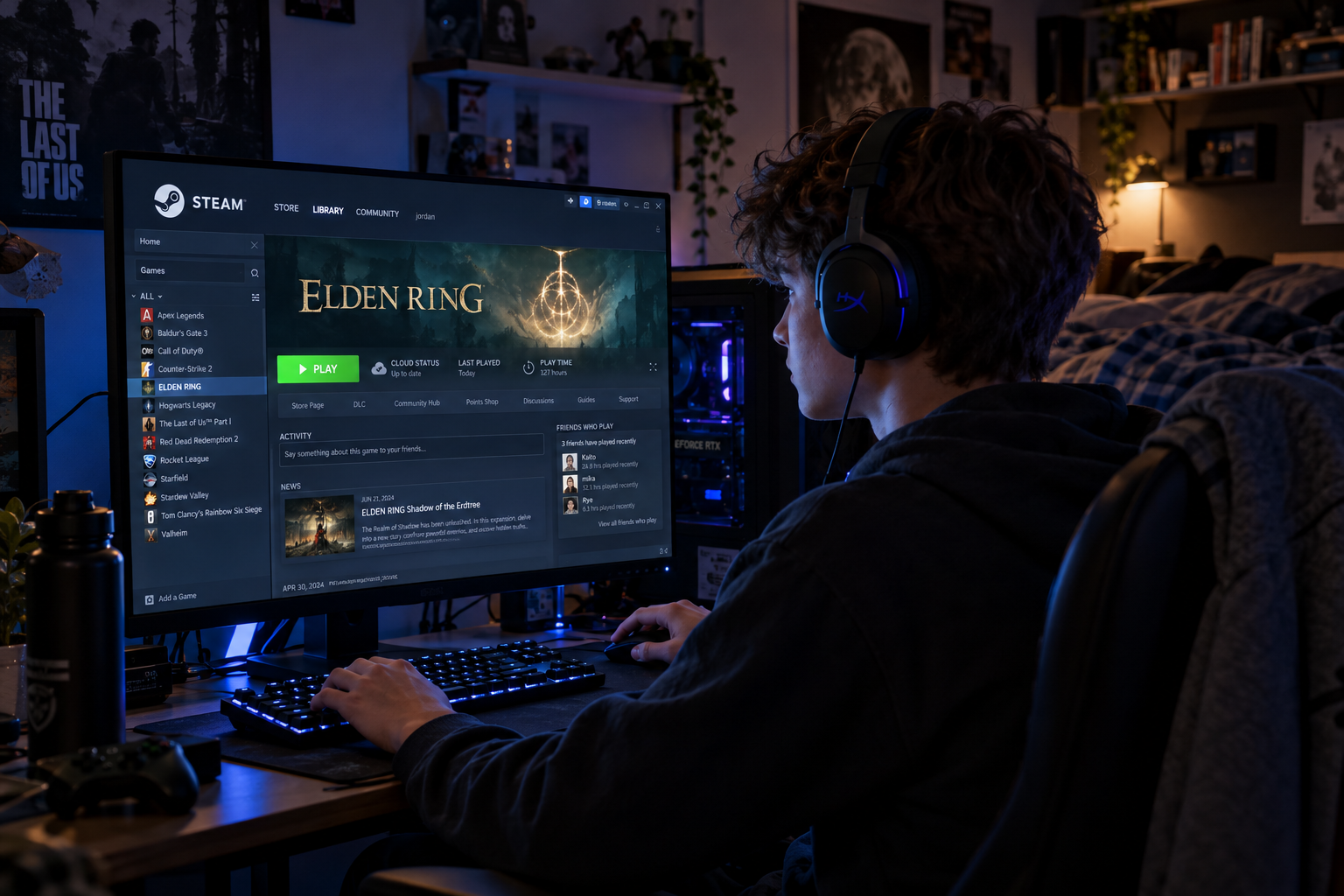
Now consider Steam. Under the Steam Subscriber Agreement, an account is strictly personal. Valve prohibits transferring it to another person without its permission. This restriction also creates a significant obstacle to passing an account to heirs.
Imagine spending twenty years building a valuable Steam library, collecting rare inventory items and purchasing hundreds of games. Under the platform’s contractual rules, your children cannot simply inherit the account as they would a collection of books or paintings.
And yet, if those same digital assets generate real income during your lifetime, the tax authorities may expect their share.
Can a private contract prevent inheritance of something that has measurable economic value? Should the publisher’s classification of an asset as a license prevail over succession law? And does it make sense for criminal law to protect virtual possessions against theft while contract law denies their transferability?
The answers are far from settled and will inevitably depend on the applicable jurisdiction, the nature of the rights involved and mandatory consumer protection or inheritance rules.
Loot boxes add another dimension to this puzzle. A player pays for the possibility of obtaining an unknown digital reward. Sometimes the result is worthless. Occasionally, it is a rare and highly desirable item. The mechanism resembles a lottery, although its legal classification varies between jurisdictions. Where rewards can be exchanged for money or other economically valuable assets, questions concerning gambling regulation become particularly relevant.
Meanwhile, microtransactions have transformed games into sophisticated digital marketplaces. Players no longer merely consume entertainment. They accumulate inventories, trade virtual assets, speculate on scarcity and sometimes generate substantial revenues. Yet their rights often remain those of licensees rather than owners.
Perhaps the legal problem is not whether a digital sword, a rare skin or a virtual coin is technically property. The deeper question is who should control the economic value created and accumulated by players.
The developer supplies the digital environment. The player supplies money, time, skill and demand. Together, they create a market in which supposedly intangible objects acquire very tangible prices.
But when the player wants to sell, transfer, recover or bequeath those objects, the boundaries of ownership suddenly become uncertain.
RuneScape demonstrated that virtual possessions can be stolen. Tax law can recognize the income they generate. The Chinese inheritance case suggests that courts may sometimes protect their transmission to heirs. And platforms such as Steam and PlayStation remind us that paying for digital content does not necessarily make us its legal owners.
Until the law develops a coherent approach to virtual assets, the gaming economy will continue to operate under a peculiar rule:
You pay like an owner, trade like an investor, get taxed like a businessperson, but may ultimately have the rights of a temporary guest.
And when the server finally shuts down, the question remains: was any of it ever really yours?